New Zealand Schools face unprecedented challenges in ensuring the safety of students online, with significant increases in cyberbullying, online harassment, and exposure to harmful content as a result of increased screen time.*
This makes digital safeguarding more crucial than ever.
*New Zealand ranks 3rd globally for cyberbullying among young people, and 40% struggle with loneliness. Netsafe Report 2023.
Digital safeguarding involves taking proactive steps to prevent online harm and abuse. Just as with traditional safeguarding, the goal is to prevent issues before they escalate. Early detection and intervention are more effective than responding after an incident occurs.
Watch Yasmin London, our Global Cyber Safety Expert explain how Digital Safeguarding works.

While filtering tools play a key role in online safety, they are no longer sufficient on their own. Schools need to proactively detect and intervene in students' online behaviours to truly safeguard them. Digital visibility - understanding students' online interactions - is crucial for identifying and addressing risks before they escalate. This visibility helps schools move from reactive to proactive safeguarding practices, ultimately improving student outcomes and digital wellbeing.
Traditionally, schools have relied on ‘stopping and blocking’ to shield students from online harm. While blocking remains important, it only addresses part of the problem. The real challenge lies in understanding what students encounter in the digital spaces they can access.
Without advanced technology, gaining visibility into a student's online activities and interactions is nearly impossible.
With digital visibility schools can:
Gain insights into students' online behaviours (what they do, say, share, and with whom), which is key to effective safeguarding.
Identify and address risks by spotting potential issues and being able to intervene early, reducing the risk of missing students in need.
Shift from reactive responses to proactive safeguarding practices.
Make informed decisions and tailor digital safeguarding strategies based on actionable insights.
To identify immediate risks and enhance visibility, schools can lean on a range of tools and systems designed to protect individuals, particularly students, from online threats and risks. Linewize provides advanced digital safeguarding solutions designed to monitor, detect, and address potential threats in real time.
Our comprehensive suite of tools supports
teachers from all sides.
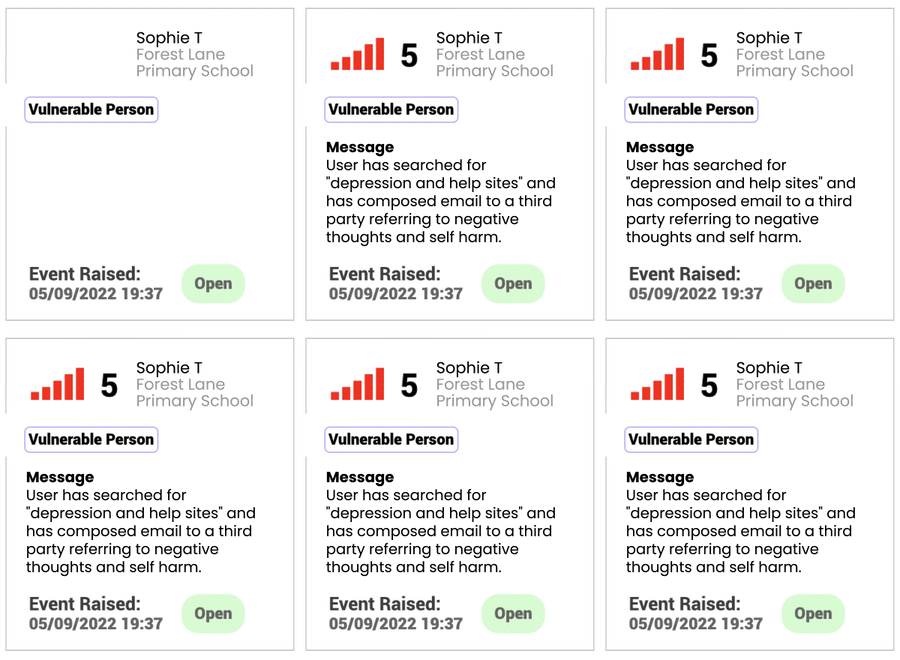
Linewize Monitor leverages keystroke technology, AI and human moderation to provide critical insights into students' online activities beyond the web browser. Continuous monitoring detects potential risks and generates instant alerts for concerning behaviour, helping to identify vulnerable students and engage relevant stakeholders promptly.


Unlike traditional, anonymous annual surveys, Pulse offers frequent, quick check-ins that only take a minute or two to complete. By asking students weekly about their feelings and gathering responses to five key sentiment and engagement questions, Pulse provides timely and actionable insights. This continuous feedback helps schools better understand student experiences, identify emerging concerns, and support digital safeguarding efforts more effectively.
Linewize School Manager offers granular control, allowing schools to target interventions at an individual student level. It delivers comprehensive visibility into students' digital interactions and issues real-time red flags for attempts to access inappropriate or harmful content. Coming soon - School Manager will go a step further with AI-driven real-time image blurring.


Linewize Classwize enhances digital safeguarding by providing teachers with the ability to review historical data through its rewindability feature. This capability allows educators to access screenshot views for up to two weeks, enabling them to track and verify student behaviour over time, identify potential risks, and address issues proactively. By offering these insights, Classwize supports a safer digital learning environment and helps ensure timely intervention in safeguarding students.

James Wheaton
Principal, Upper Harbour Primary.
James discusses how the use of Linewize Monitor at the school has given all-important visibility into what students are doing online coupled with the ability to identify those who may need help or support.
We use cookies and similar technologies to make our website work, to understand how it is used, and, with your permission, to personalise content and show you relevant advertising on other platforms. Some of these technologies are provided by our partners. Essential cookies are always on, because the site cannot function without them. Everything else stays off until you choose to turn it on. You can accept all, reject all non-essential cookies, or set your own preferences, and you can change your choice at any time. For more detail, see our Cookie Policy and Privacy Notice.
In the US? You also have the right to opt out of the sale or sharing of your personal information and to limit the use of your sensitive personal information. Manage these under "Your US privacy choices".
While some cookies are necessary to make our website and services function properly, consent for all non-essential cookies has been automatically declined. You can change your preferences at any time. To find out more about the cookies we use, see our Cookie Policy and Privacy Notice.
Choose which cookies and technologies you are comfortable with. Essential cookies keep the site secure and working, so they are always on. You can switch the other categories on or off, then save your choices. You can return here at any time to change them. See our full list of cookies.
These cookies and technologies are needed for the site to work safely and reliably. They support core functions such as security, network management, bot and fraud protection, and remembering your privacy choices. The site cannot run without them, so they cannot be switched off.
Providers: Cloudflare, HubSpot
We use a set of cookies that are optional for the website to function. They are usually only set in response to information provided to the website to personalize and optimize your experience as well as remember your chat history.
Providers: HubSpot
These help us understand how visitors find and use our website, including which pages are viewed and how people navigate and interact with them, so we can improve it. Some of this involves recording how pages are used. We do not use this information to advertise to you.
Providers: Google, Hotjar, HubSpot, Microsoft.
These let us measure how our campaigns perform and show you relevant advertising on third-party platforms, such as search engines and social media. They involve sharing limited information with advertising partners, who may combine it with data they already hold. For US visitors, turning this category on allows the "sale" and "sharing" of personal information for cross-context behavioral advertising, as those terms are defined under US state privacy laws.
Providers: Google, HubSpot, LinkedIn, Microsoft, Reddit.
If you are a resident of a US state with a comprehensive privacy law (such as California, Colorado, Connecticut, Texas, Virginia and others), you have additional rights over how your personal information is used. You can exercise the choices below without affecting your access to our website.
When our advertising and marketing technologies are active, we may sell or share your personal information for cross-context behavioral advertising. To opt out, switch off the Advertising and Marketing category above, or use the toggle here.
Where we process sensitive personal information, such as precise geolocation, you can ask us to limit its use to what is necessary to provide our services and other purposes permitted by law.
We recognize browser-based opt-out preference signals. If your browser or device sends a Global Privacy Control signal, we will treat it as a valid request to opt out of the sale and sharing of your personal information for that browser or device.
We do not knowingly sell or share the personal information of consumers under 16, and we do not use it for targeted advertising, without the consent required by law. We do not knowingly collect personal information from children under 13 without verifiable parental consent.
Changed your mind?
You can withdraw or update your consent at any time using the "Cookie settings" link in our website footer.