Justin Somerville
Principal, Halsey Drive School
Most schools already have digital safety measures in place. Filtering is on, Safe Search is enforced, and students are using school accounts, and for a long time, that’s been considered enough.
But what many schools are starting to realise is that filtering shows you where students go, not always what happens once they get there.
A student doesn’t need to visit an inappropriate website to come across something they shouldn’t; it can happen inside a search result, within a shared document, or on a platform that’s already allowed. Because these spaces aren’t always visible, it can create a false sense of confidence: Nothing looks wrong, until something is.
As Justin put it, “We assumed we were keeping students safe… until we realised we weren’t seeing the full picture.”
This is where gaps begin, not because schools aren’t doing the right things, but because those protections don’t always go far enough for how devices are actually being used.
The question isn’t whether filtering is in place, it’s whether it’s giving you the full picture.
Gaps don’t usually sit in obvious places. They look like...
a search that returns more than expected.
a conversation happening inside a shared document.
Individually, these moments seem small.
But together, they create blind spots tamariki fall through.
This page brings together what schools are learning, and what can be done to close these gaps.
Closing the gaps that children fall through

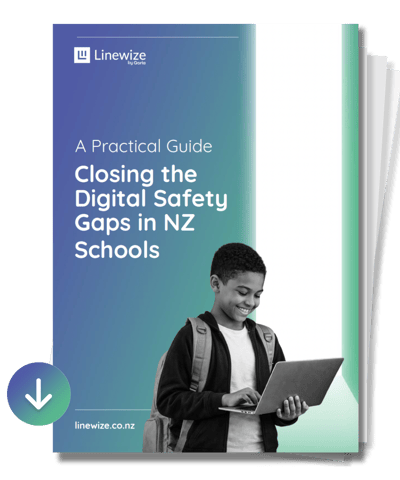
If any of this feels familiar, you’re not alone. We’ve pulled together a practical guide to help you work through this with your team.
Inside, you’ll find:
It’s something you can take into a staff meeting, sit with your leadership team, or use to start a wider conversation across your school.
This webinar is designed to support leaders and pastoral staff at the start of the year, as students return to school and their devices.
Brought to you by Makes Sense and Linewize, with a special guest from
Halsey Drive School.
Jo Robertson
School Board Member & Parenting Educator, Makes Sense
Holly Brooker
Educator, Advocate & Media Specialist, Makes Sense
Justin Somerville
Principal, Halsey Drive School
Saunil Hagler
NZ Education Director, Linewize
For most schools, closing the gaps comes down to three things. Let’s explore them in more detail:
Moving beyond blocked content
Filtering still plays an important role, but it’s no longer enough on its own. Schools are starting to look beyond whether a site is allowed or blocked, and instead focus on what students are actually seeing and doing within the spaces they can access.
.gif?width=400&height=284&name=US_LWZ_2024_School_Manager_Content_Aware_Mockup_4%20(1).gif)
Noticing earlier, anywhere
It’s the combination of visibility in spaces we assume are safe (like chats and collaborative documents) and the timing to respond early and appropriately. With the right context, and the right people notified based on severity, and patterns over time, responses can be timely, informed, and appropriate.
/Mockups/bord-in-class.gif?width=400&height=270&name=bord-in-class.gif)
Extending that visibility beyond the classroom
Digital behaviour doesn’t stop at the school gate. Schools are thinking more about how that same level of awareness and support can continue beyond school hours, giving parents greater confidence and a clearer role to play.
If these insights feel familiar, you’re not alone.
Many schools are in this exact position, doing some things right, but starting to question whether what they have is enough.
If you’d like help reviewing your current approach, or simply want a second perspective, we’re here to help.
Request a conversation by filling out the form.
Principal, Wellesley College
Talk to an expert or book a demo. Our Digital Wellbeing experts are waiting to help.